Maintenance application icon — a gauge dial with a wrench Product

Advanced service intervals and service history for Wialon fleets.

Maintenance tracks mileage, engine hours and elapsed days against your service intervals and marks each one OK, Due or Overdue. Intervals are stored as Wialon service intervals on the unit, so they are the same objects Wialon shows. Completed work is logged with parts, labour, cost and file attachments.

What it looks like

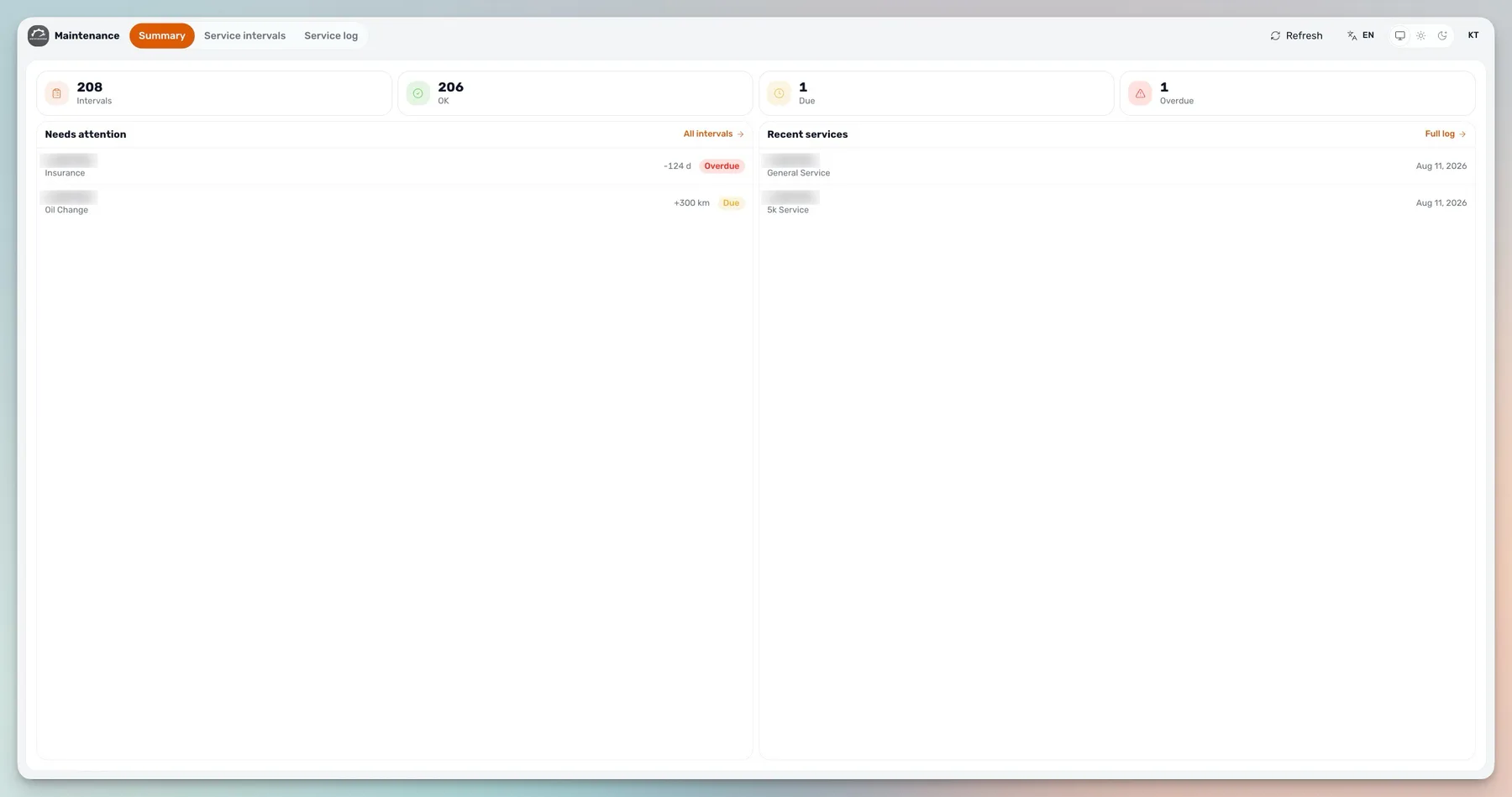
Maintenance summary tab listing intervals needing attention and recent services

Why this exists

  • A warning window the interval has no field for

    The interval carries a frequency, so a unit is either before or after the threshold. Maintenance adds a warning window per axis and marks anything inside it Due. Intervals created in Wialon start on a default of 500 km, 20 engine hours and 14 days until you set your own.

  • Due and Overdue in real time, not only on alert

    Wialon reports an approaching or missed service through notifications, unit by unit as each threshold is crossed. Maintenance also recalculates every interval against the unit's current odometer and engine hours on each page load, so the whole fleet's status is on screen when you want to plan the week. Notifications keep working alongside it.

  • Service history normally has a horizon

    Service records held as Wialon messages last as long as the account keeps history. Fleetrun holds five years. A service interval on its own holds one year, or however long that unit's history is retained. Maintenance stores the record on the unit itself and is not tied to that period, so the log keeps the whole life of the vehicle.

Who it is for

  • Fleet and workshop managers already tracking service in Wialon who need to see what is approaching, not only what has passed.

  • Wialon partners who want a maintenance application under their own brand without running a separate maintenance database.

What you get

  • Three axes, one status

    Intervals run by mileage, engine hours, days, or any combination. When more than one axis is tracked, the worst one decides the status: fine on kilometres and past the calendar rule still reads Overdue.

  • Advance notice per axis

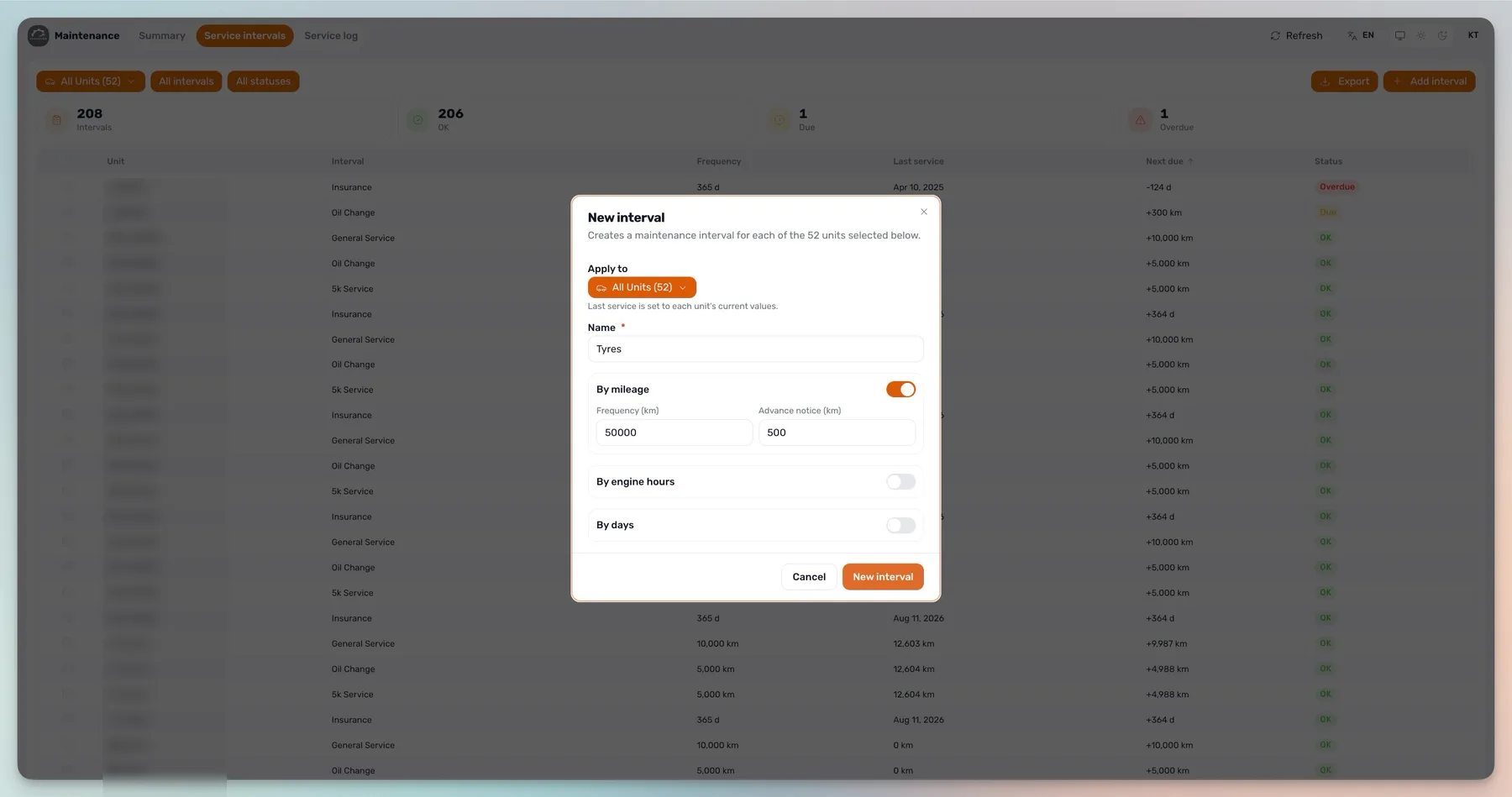
    Set how far ahead to warn in kilometres, hours and days independently. Anything inside the window reads Due rather than OK, on screen, without waiting for a notification to fire.

  • Intervals stay in Wialon

    Intervals are Wialon service intervals on the unit. Create one here and it exists in Wialon; create one in Wialon and it appears here. There is no second database to keep in step.

  • Batch across the fleet

    Apply an interval to many units in one action. Units already at Wialon's per-unit interval limit are reported as skipped rather than failing the batch silently.

  • Parts, labour and cost

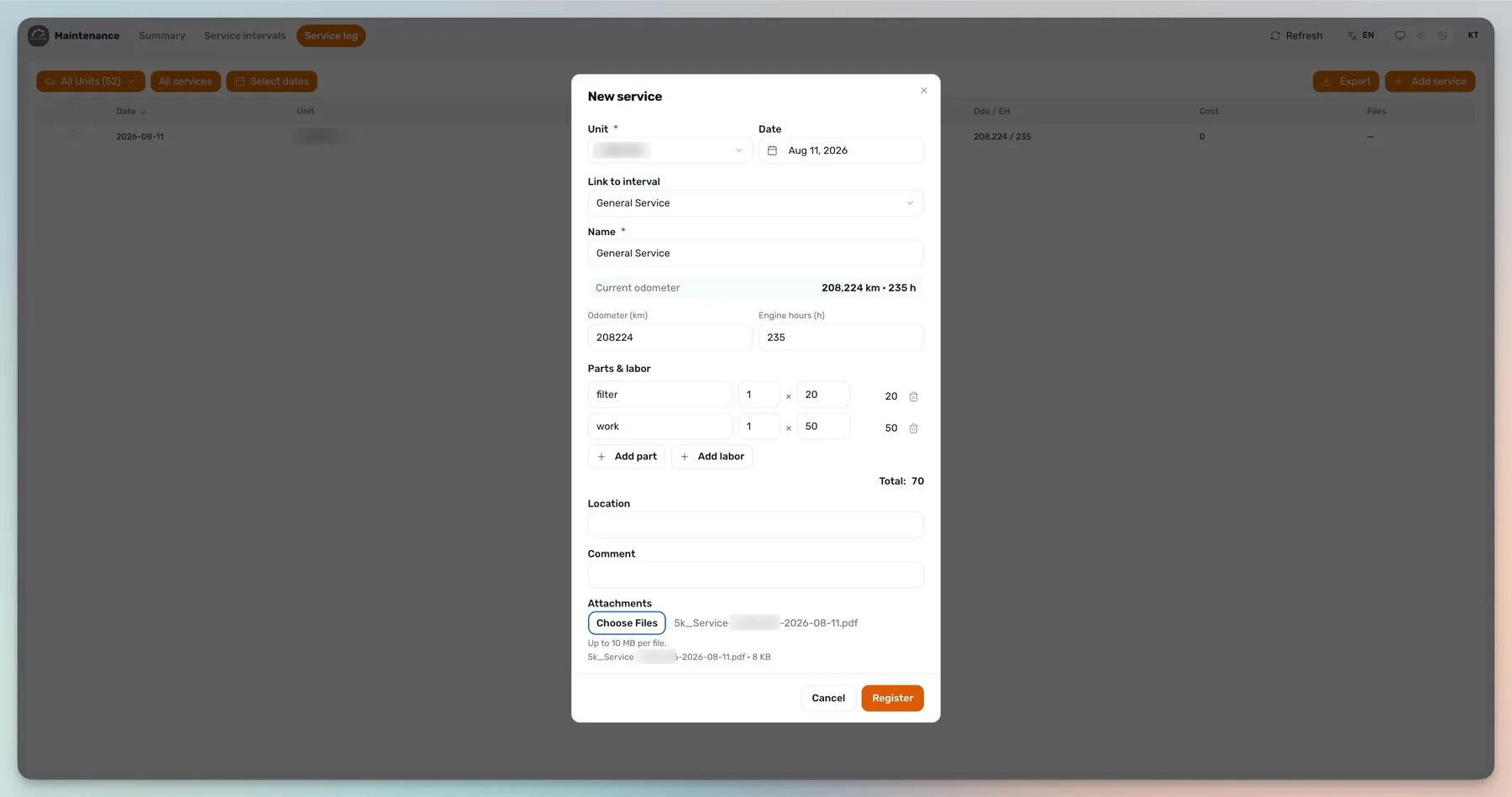
    Parts with quantity and cost, labour with hours and rate, a running total, location and comments. Linking a service to an interval moves that interval's baseline and advances the next due date.

  • History that does not expire

    Service records live on the unit and are not tied to the account's message-history period, so last year's work is still there when a warranty claim or a resale valuation needs it.

  • File attachments

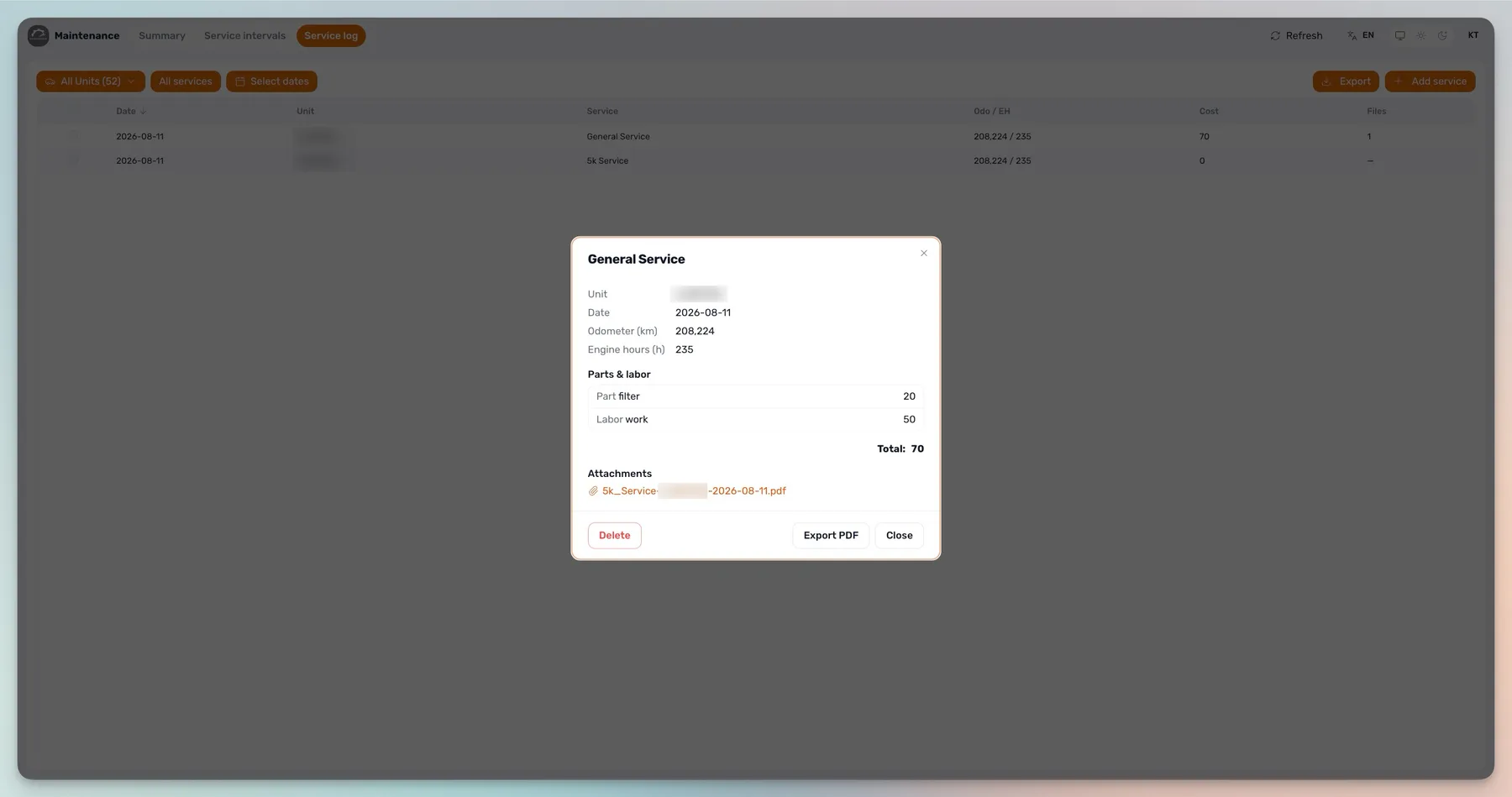
    Invoices and photos attach to the service record, up to 10 MB each. The per-service PDF embeds image attachments and copies the pages of PDF ones into the same document.

The data itself

  • Intervals

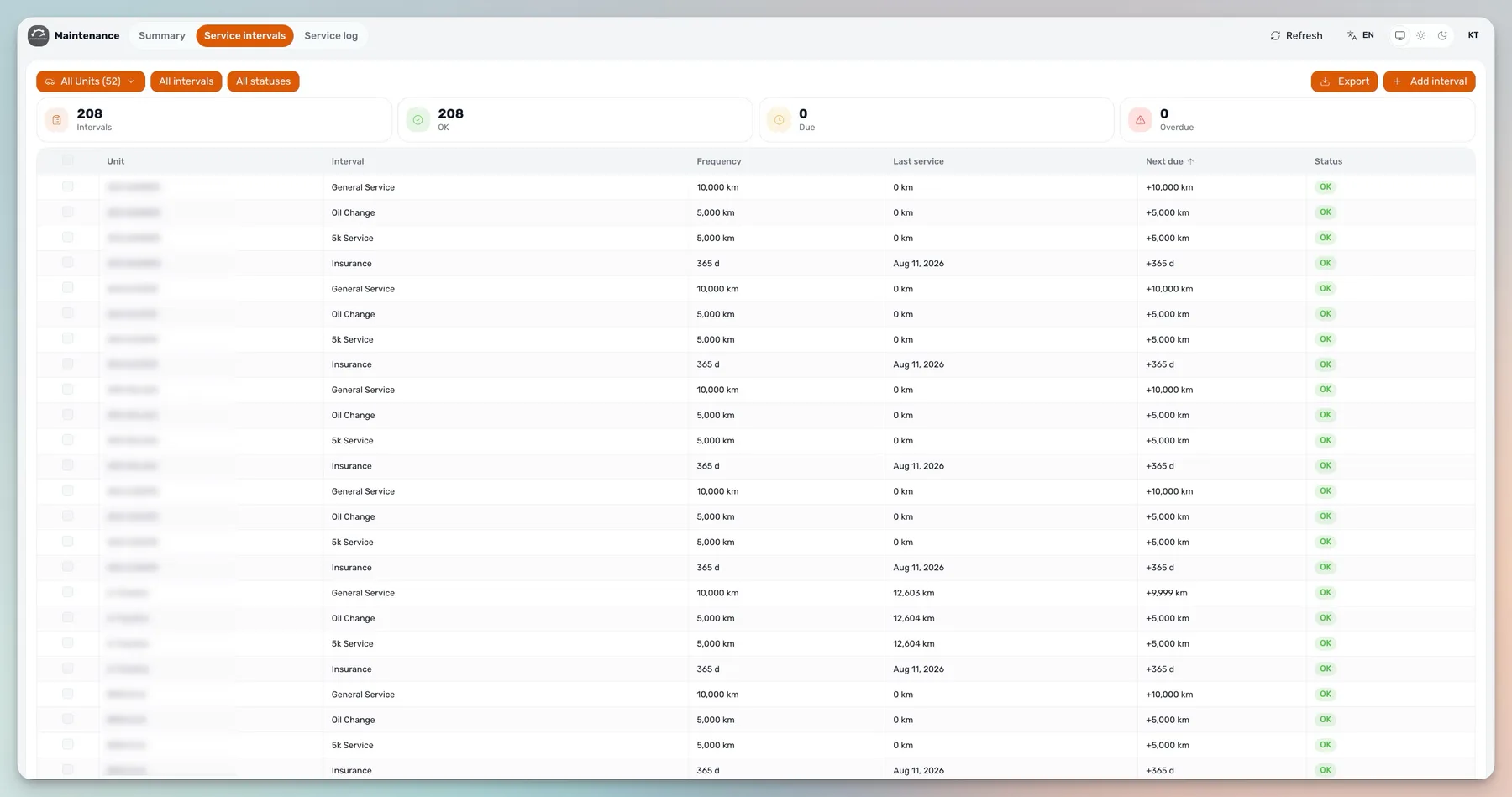
    Unit, interval, frequency, last-service baseline, and what is left on each axis with its sign: +9,684 km is distance still to run, −12 d is twelve days past the calendar rule.

  • Statuses

    OK, Due and Overdue, recalculated against the unit's live odometer and engine hours on every page load rather than cached.

  • Services

    Date, unit, service name, odometer and engine-hour readings, total cost and attached files. Filterable by vehicle, service name and date range.

How to get started

There is no Maintenance account to create. Either sign in against your Wialon server, or register Maintenance as an application in the CMS so it opens from Wialon already authenticated.

  • Option A: Sign in with Wialon credentials

    1. 1. Open the app.
    2. 2. Choose your Wialon server.
    3. 3. Sign in with Wialon, using Wialon's own login.
  • Option B: Register it in the Apps configurator

    1. 1. In Wialon CMS Manager, create a new application.
    2. 2. Point it at the URL below and enable the listed advanced URL parameters.
    3. 3. Maintenance then opens from inside Wialon with the session already established.
    Advanced URL parameters
    Active SID · Host URL · Current user · Base URL · Authorize hash

How it connects

  1. Step 1: Your intervals appear

    The service intervals already on your units in Wialon are listed as soon as you sign in. There is no import step.

  2. Step 2: Set the warning windows

    Intervals that came from Wialon start on a default window of 500 km, 20 engine hours and 14 days. Edit them to match how far ahead your workshop needs to know.

  3. Step 3: Create what is missing

    Create intervals across a group of units in one action, with frequencies on any combination of mileage, engine hours and days.

  4. Step 4: Register work as it happens

    Log the service against the interval with readings, parts, labour and the invoice. The baseline moves and the next due date advances on its own.

White-label

Maintenance ships white-label: partners deploy it under their own brand and domain.

  • Your brand and your domain; the customer sees your product rather than ours.
  • Intervals live in the customer's own Wialon account, so the data stays with them if the relationship ends.
  • You hold the commercial relationship and the billing.
  • Product work and Wialon API changes are handled on our side.

Security and access

  • Authenticates against Wialon. There is no separate account and no Wialon password stored here.
  • Intervals are written to the customer's own Wialon account, so the maintenance schedule is theirs and stays after any change of supplier.
  • Service attachments are capped at 10 MB per file.
  • Deleting a service removes its attachments and the underlying Wialon maintenance event. This cannot be undone.

Also from Asset Track

FAQ

How is this different from the servicing already in Wialon?

It works on the same data: the service intervals Wialon stores on the unit. What it adds is a warning window, which the interval itself has no field for, creating an interval across many units in one action, a live view of every status rather than an alert per unit, and a service record carrying parts, labour, a running cost total and file attachments.

Do we have to migrate anything?

No. Intervals already configured in Wialon appear as soon as you connect, and anything created here is written back to Wialon. There is no import step and no second source of truth to reconcile.

What happens to intervals created in Wialon's own interface?

They appear here with a default warning window of 500 km, 20 engine hours and 14 days, because Wialon has no field to carry one. Edit the interval once and your own window replaces the default.

Do we still need Wialon notifications?

You can keep them. Notifications tell you the moment one unit crosses a threshold. Maintenance shows where every interval stands right now, recalculated against live odometer and engine-hour values on each page load. Most fleets use the screen for planning the week and notifications for the thing that cannot wait.

How is status decided when an interval tracks more than one axis?

The worst axis wins. An interval fine on mileage but past its calendar rule reads Overdue, not OK. Status is recalculated against the unit's live odometer and engine hours every time the page loads rather than served from a cached value.

Can we attach invoices?

Yes, files up to 10 MB each attach to the service record. The single-service PDF export embeds image attachments and copies the pages of PDF attachments into the same document, so one file can go to finance or to an auditor.

Can we sell it under our own brand?

Yes, under your brand and domain. Because the intervals live in the customer's Wialon account, you are adding a working surface rather than a dependency.

How long is the service history kept?

For the life of the vehicle. Service records held as Wialon messages last as long as the account keeps history: five years in Fleetrun, and one year for a service interval on its own, or however long that unit's history is retained. Maintenance stores the record on the unit itself and is not tied to that period, so a service from six years ago is still readable. It stays in the customer's own Wialon account throughout.

Related

Guide · Integration

Wialon Maintenance Reminders

Track Wialon service intervals by mileage, engine hours or days, log completed services with parts and cost, and see what is due or overdue.

Read more
Contact

Let's connect.

About Us

Helping businesses to make their fleets safer, teams more productive and processes more efficient.